Solutions
  Products
  Industries
 Resource Center
  Company
  Contact

 North America
  Europe
  Deutschland
  Asia-Pacific
  Canada (Français)
  Africa
  Argentina
  México
  Brasil
 Six months. That’s how long BC commercial fleets will have to comply once Bill M217 receives Royal Assent.
The bill passed third reading on 26 May 2026, with unanimous, bipartisan support. This makes British Columbia poised to become the first Canadian jurisdiction to require forward-facing dash cameras on commercial vehicles operating on BC highways.
It’s a big deal, and the compliance clock is already ticking in practical terms, even if the official countdown hasn’t started yet.
Most fleet operators will treat this as a box to check. Find a camera, get it installed, and done. That’s one way to handle it. But if the ELD rollout taught us anything, it’s that fleets that used the mandate as a reason to modernize came out well ahead of those who did the bare minimum and moved on. This bill presents an opportunity for fleets to move beyond simply preparing for compliance and begin building a long-term video safety strategy that delivers operational and risk-management benefits today.
What fleets actually need to do
The requirements are clear. Commercial vehicles operating on BC highways need a forward-facing dashcam that records continuously while the vehicle is running. Based on current regulatory guidance, the minimum technical specifications are 1080p resolution, at least 72 hours of footage retention, and night vision.
The BC Trucking Association supported the bill because the data backs it. In 75 to 80 percent of crashes involving a commercial vehicle, the truck driver wasn’t at fault. But without objective video evidence, proving that can be difficult. A camera helps provide that record.
We’ve been here before
When the federal ELD mandate took effect, the conversation started the same way. Compliance deadline, scramble to install, get it done. But the carriers who got ahead of it didn’t just tick the box. They used it as a trigger to clean up their operations: integrated telematics, better visibility, and tighter workflows.
Fleets that operate nationally should view this as an early indicator of where fleet safety regulations may be headed across Canada. BC is first on dashcams. It won’t be last. Alberta, Ontario, and Manitoba are watching. Fleets that build their video safety programs now will be in a much better position when the next province follows.
That preparation window is open now. Fleets that act early will have more control over timing, installation, and rollout.
A forward-facing camera is the starting point, not the full picture
Meeting the mandate requirements is an important first step. However, fleets that view video solely as a compliance requirement may be overlooking a much larger opportunity. While Bill M217 focuses on basic video recording requirements, it reflects a broader shift in how regulators, insurers, and fleet operators view video technology as an essential component of modern fleet safety.
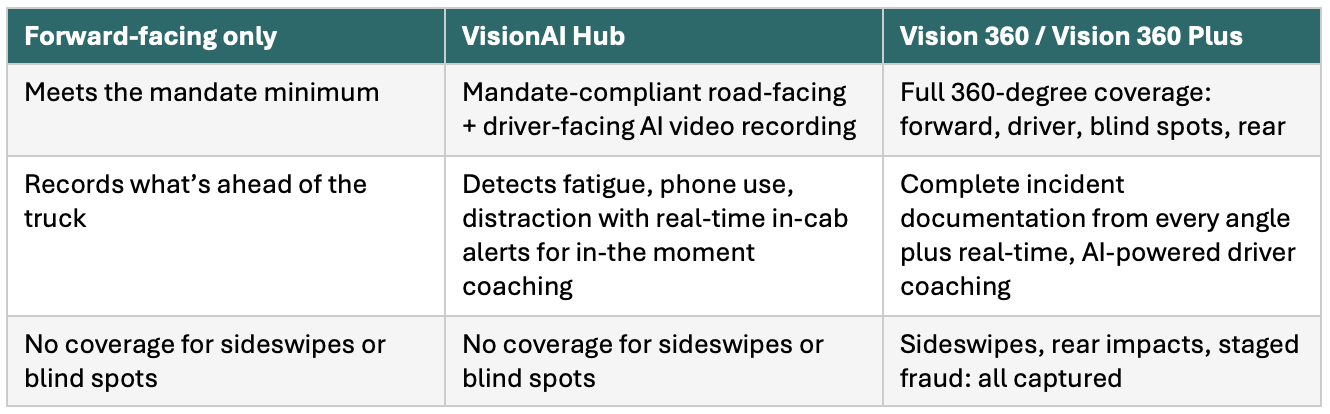
The mandate requires forward-facing cameras. That’s the minimum. The problem is that most real incidents don’t happen directly in front of the truck.
Sideswipes happen on the sides. Rear-end collisions happen from behind. Staged accident fraud, which is up 400 percent year-over-year in Canada, according to Aviva Canada, comes from every direction. And driver distraction? That happens inside the cab, completely out of frame if you only have a road-facing lens.
A forward-facing camera helps satisfy the mandate. Broader video visibility helps protect the business when incidents, claims, and questions about driver behavior become more complex.
Compliance keeps you legal. Full visibility keeps you protected.
Which solution best fits your fleet
Not every fleet needs the same thing. The right starting point depends on your vehicle type, your risk exposure, and how seriously you intend to run your safety program going forward.
The compliance journey
Dashcam Compliance > Driver Protection > Incident Prevention > Fleet Safety Transformation
What Powerfleet’s AI Video solutions do that a basic camera can’t
If you’re going to install something anyway, it’s worth understanding what you’re getting beyond the minimum. Powerfleet’s VisionAI solutions aren’t just cameras. They actively help prevent incidents, not just record them.
- In-cab alerts: AI detects distraction, fatigue, and seatbelt non-use and alerts the driver in real time, before something happens.
- Driver risk insights: High-risk drivers and recurring behaviors can be surfaced through scoring and event trends, so coaching is focused where it is needed most.
- Automated event review: AI flags what matters and can reduce manual video review time by up to 95 percent.
- Unity platform connection: Powerfleet’s AI Video solutions run on the same platform as its ELD, telematics, and fleet-tracking tools, so everything is in one place.
- Simple installation: VisionAI Hub is plug-and-play, up and running in minutes, no specialist needed.
What this looks like in practice
La Flèche Rouge Express, based in Quebec, operates more than 120 trucks across North America. After deploying Powerfleet Vision AI, they shifted from reacting to incidents after the fact to catching risky behavior before it became a problem. Incidents dropped by 50 percent. Maintenance improved on the same platform. Watch the customer story video to learn more.
The Miller Group used VisionAI to gain real-time visibility into risky driving behaviors and coach drivers before incidents occurred. These AI-powered insights improved driver accountability, reduced risk, and strengthened overall safety performance across the fleet. Read the full case study to see VisionAI in action.
Neither of these started as a safety transformation project. Both started with a technology decision.
Getting ahead of the mandate
Royal Assent hasn’t happened yet, so the official clock hasn’t started. But demand for dashcam installations across BC will spike the moment it does. Lead times for hardware and installation will lengthen. Pricing will reflect the rush, and project timelines may become harder to manage.
Fleet managers who are getting ahead of this now are taking a few practical steps: auditing whether any existing cameras meet the 1080p, 72-hour, night-vision spec; mapping which vehicles still need to be equipped; and deciding whether this is a compliance-only project or an opportunity to upgrade their safety program.
BC’s commercial dash cam mandate signals a new era of fleet safety accountability. Fleets that act early won’t just be prepared for compliance, they’ll be positioned to better protect drivers, reduce risk, and improve operational performance. As fleet safety requirements continue to evolve, investing in modern video technology today can help position your organization for future compliance needs and deliver immediate operational value.
Ready to sort your compliance?
Whether you’re evaluating your first dash cam deployment or modernizing an existing video program, Powerfleet can help you develop a solution that supports compliance and long-term safety objectives.
Powerfleet’s VisionAI Hub and Vision 360 solutions are already in use across Canadian fleets. Getting yours compliant before the BC deadline doesn’t require a new vendor, a lengthy implementation, or a complicated decision. For most fleets, it’s a straightforward upgrade.
Talk to a Powerfleet expert about BC mandate compliance and what VisionAI Hub or Vision 360 can do beyond the minimum requirement.