 Solutions
  Products
  Industries
 Resource Center
  Company
  Contact

 North America
  Europe
  Deutschland
  Asia-Pacific
  Canada (Français)
  Africa
  Argentina
  México
  Brasil
 Forklift Analytics Cut Damage Costs 85%
New lift truck metrics help save a food and beverage maker over $2 million
Challenge: In a hyper-competitive market, do more with what you have to cut costs
Five years ago, a leading multinational food & beverage company deployed Powerfleet's forklift telematics system to improve material handling safety. The project was a big success. Based on its initial return on investment (ROI), the company rolled out Powerfleet across more than 2,500 pieces of material-handling equipment at almost 100 of its food and beverage manufacturing and distribution sites in North America.
But with more than $60 million invested in its material-handling fleet—and a labour cost of over $200 million to operate it—the Customer wanted to find out whether Powerfleet could save it even more money.
Centre of excellence looks to expand use of Powerfleet
This company has a long history of using cutting-edge supply chain technology. For example, it is a leader in blockchain technology for sharing data securely across the food supply chain to help ensure food safety. The Company’s Centre of Excellence (CoE) focuses on continuous improvement in manufacturing and distribution, with data as its lifeblood.
To find new ways to reduce material handling costs, one of the key data sets the CoE wanted to understand better was the relationship between lift truck safety and productivity.
With Powerfleet forklift telematics already in place across the company’s entire fleet of lift trucks, the CoE didn’t have to look far to find the data-driven solution it needed.
Solution: Powerfleet’s Enterprise Dashboards
To gain deeper insight into the costs of lift truck safety, operator efficiency, and material handling velocity, the company licensed Powerfleet’s Enterprise Dashboards, a Powerfleet software option, to integrate data from multiple sources.
Specifically, the company wanted to use Powerfleet’s Enterprise Dashboards to blend these key data points:
- Number of damage-causing impacts recorded by forklift operators
- Time forklift operators spent actively working
- Number of pallets moved by lift truck operators
Key considerations
Before launching a new technology for its material-handling workforce, the company knew from experience that it needed to plan carefully and be proactive about how it would use the data.
One of the pitfalls of data-driven technology, like Powerfleet’s Enterprise Dashboards, is that the data can be overwhelming. Another challenge is translating the data into action. All too often, a flood of data is received passively, without a clear vision of what to look for or how to react.
For any new system to succeed, the people who will receive the data need to know in advance what they will be looking for—and exactly what they are supposed to do with it.
A carrot and stick plan
The company knew that for Powerfleet’s Enterprise Dashboards to be most effective, key employees—lift truck operators, line supervisors, facility managers, and corporate management—needed to care about the outcome. The company had to make more than a financial investment; it had to engage and motivate these stakeholders.
The key to making workers care is accountability. So the company devised a “carrot-and-stick” plan with both incentives for “good” behaviours and consequences for “bad” behaviours. Using data surfaced through Powerfleet’s Enterprise Dashboards, the company:
- Developed a consistent set of metrics for material-handling productivity and safety, regardless of facility type or size, or the makeup of a site’s lift-truck fleet.
- Established new benchmarks for pallet moves, lift truck motion time, and impact events.
- Set up key performance indicator (KPI) scorecards for drivers, supervisors, and warehouse managers.
- Awarded cash bonuses and other incentives for meeting target KPIs.
- Retrained or reassigned forklift operators who failed to meet the benchmarks for safe productivity.
Results: Deep data insights cut forklift damage by 85% while meeting/exceeding pallet-move goals
To better measure which sites and people needed a better balance between material-handling productivity and safety, Powerfleet worked closely with the company to integrate its Kronos® time-card system and SAP® warehouse management system (WMS) with Powerfleet’s Enterprise Dashboards. This created a whole new set of integrated data points, such as:
- Lift truck operator paid-time vs. seat-time, deadhead-time, and time-in-motion-with-load
- Lift truck impacts vs. number of pallets moved
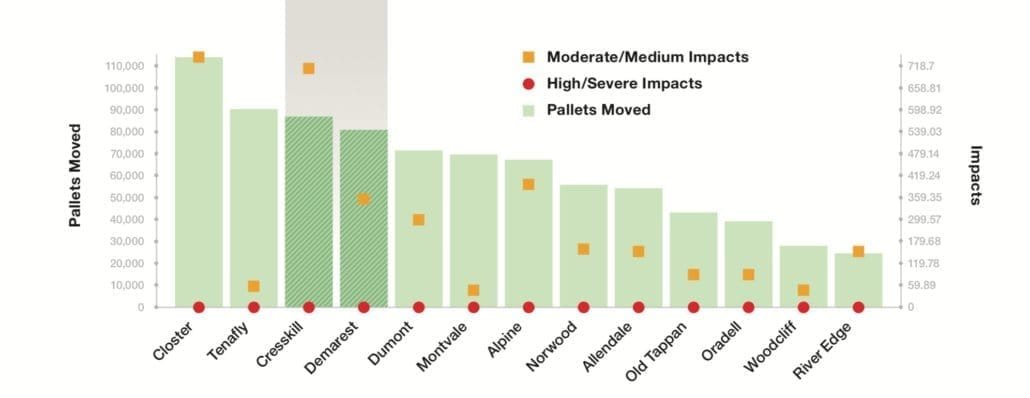
An excerpt of the latter type of chart is shown below, with the data aggregated by site. In this example, “Site 2” moves almost as many pallets as “Site 3,” but significantly higher moderate and medium impact events. The user can click on any site to drill down into individual driver performance at that site, to determine which operators were at the root of the data.
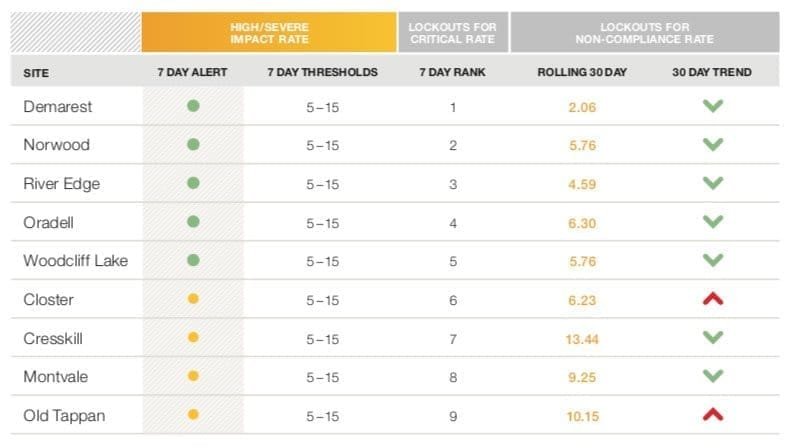
Powerfleet and the customer also built KPI scorecards, allowing key metrics to be quickly understood. The following examples focus on, respectively, forklift fleet safety and productivity, by site. In the KPI scorecard excerpted below, the screen shows the 7-day safety rankings and 30-day trends of each site, based on their forklift fleets’ rate of high and severe impacts. Green dots indicate compliance with corporate standards; yellow dots suggest improvement is needed. (Red dots would indicate a site’s performance is unacceptable).
The next KPI scorecard excerpt ranks sites by forklift fleet efficiency, based on the amount of time vehicles spend in motion compared to the time vehicle operators are logged into the equipment. Sites 6 and 11 both complete the same amount of work in the period, with the highest activity hours. However, Site 11 is more efficient with more than 30% greater ratio of motion (time vehicles are moving) to login (time drivers are logged in). This highlights how different sites can vary in operational efficiency despite similar amount of completed work.

"Powerfleet’s Enterprise Dashboards drove much safer lift truck operations without a loss of material velocity: 85% less forklift damage and 100% of target pallet moves ... for over $2 million in cost savings across the enterprise."
Process for validation and action
The first key role of Powerfleet’s Enterprise Dashboards was to validate data accuracy. One KPI scorecard monitored the health of system components, particularly to confirm that the Forklift Gateway (VAC) was collecting data normally and attributing it to identified operators. With validated data flowing smoothly, the company conducted several months of analysis without acting on the data. This enabled the company to set expected benchmarks without rushing to judgment about individual operator performance. Importantly, the established benchmarks were ratios (not absolute numbers) to normalise performance across operators, vehicle types, and sites with different operating patterns.
The most critical benchmark ratios were:
- Pallets moved to severe forklift impacts (which have a high correlation to damage) and to medium forklift impacts (an indicator of excess wear and tear over time)
- Vehicle motion time to operator login time to Kronos® shift time
Also significantly, Powerfleet’s Enterprise Dashboards enabled different standards to be set for different vehicle types, and accounted for drivers who operated different types of vehicles on the same shift or day.
Based on these benchmark ratios, the company set up multiple KPI scorecards for different stakeholders: individual drivers (with daily, weekly, and monthly metrics); supervisors (focused on all drivers each shift); warehouse managers (with a view of the entire facility); and corporate management (with stack-ranking of all sites in a single view).
This data hierarchy enabled a rapid, logical flow of information and decisions. Corporate management identified high- and low-performing sites. Facility managers saw how they ranked compared to other sites and where they stood relative to the target benchmarks. Line supervisors drilled down to understand which forklift operators were high achievers—and which needed refresher training. And forklift operators could see in black and white where they stood.
In the end, the food & beverage company was able to drive much safer lift truck operations while maintaining high material velocity through its distribution system. The result was an 85% reduction in forklift damage costs with 100% achievement of target pallet moves.
Why Did Powerfleet’s Enterprise Dashboards work so well?
“We worked with Powerfleet to integrate data from several systems and set up new benchmarks for safety and productivity. We validated the data, then analysed it to identify specific opportunities to improve. By focusing on the sites and people that needed the most improvement, we were able to reduce forklift damage costs 85% while maintaining—or exceeding—our goals for pallet moves.”
— National Warehouse Manager
That damage reduction equated to well over $2 million in cost savings across the company’s enterprise.
Conclusion: New ways of combining and analysing lift truck data can radically improve material handling operations
Using Powerfleet’s Enterprise Dashboards, this food and beverage company was able to change the way it measured and balanced productivity (pallets moved) with safety (forklift collisions) and efficiency (active time on equipment vs. paid time). This data enabled a new approach to the material-handling discipline, with high performers rewarded with financial and other incentives and low performers trained to improve. The bottom line was a stronger safety culture, with a new way to measure and manage productivity.
- Compliance with key safety metrics increased to essentially 100%
- Accidents and damage decreased more than 85%, while pallet moves remained at target levels
- Company-wide, Powerfleet’s Enterprise Dashboards helped add more than $2 million in cost savings to the bottom line