Solutions
  Products
  Industries
 Resource Center
  Company
  Contact

 North America
  Europe
  Deutschland
  Asia-Pacific
  Canada (Français)
  Africa
  Argentina
  México
  Brasil
 Every operation generates data. Vehicles report location, engine health, and fuel or energy use. Warehouse systems track inventory and order status. Safety tools log incidents and near misses. Compliance software files the paperwork required by regulators. The trouble starts when none of these systems talk to each other.
A data silo isn’t really a technology failure. It’s an organizational one. It happens when information is locked in a single system, department, or spreadsheet, and no other part of the business can access it without asking someone to pull a report. In fleet and warehouse operations specifically, silos form naturally: road operations and warehouse floors have historically been run by different teams, using different tools and reporting on different metrics.
This is the gap unified platforms are built to close. They do not have to replace every system. The value comes from connecting fleet, warehouse, safety, compliance, and third-party data into one view teams can trust. For many businesses, that means treating warehouse-to-road operations as one connected workflow, not two separate worlds.
What causes operational data silos in fleet and warehouse operations?
Most silos aren’t created on purpose. They build up over years as operations add new systems to solve immediate problems without a plan for how those systems will share data. In a typical fleet and warehouse environment, this might include:
- Fleet management systems tracking vehicle location, driver behavior, and fuel or energy use
- Asset tracking systems monitoring trailers, containers, or high-value equipment
- Warehouse systems managing inventory, picking, and order fulfillment
- Safety systems capturing incidents, near misses, and video footage from vehicles or warehouse floors
- Compliance systems managing hours of service, inspections, or regulatory reporting
- ERP systems running finance, procurement, and broader business operations
Each of these is usually justified on its own. A warehouse team adopts a new inventory platform because the old one can’t handle order volume. A safety team adds video monitoring because insurance requirements demand it. A fleet team brings in vehicle tracking to control costs.
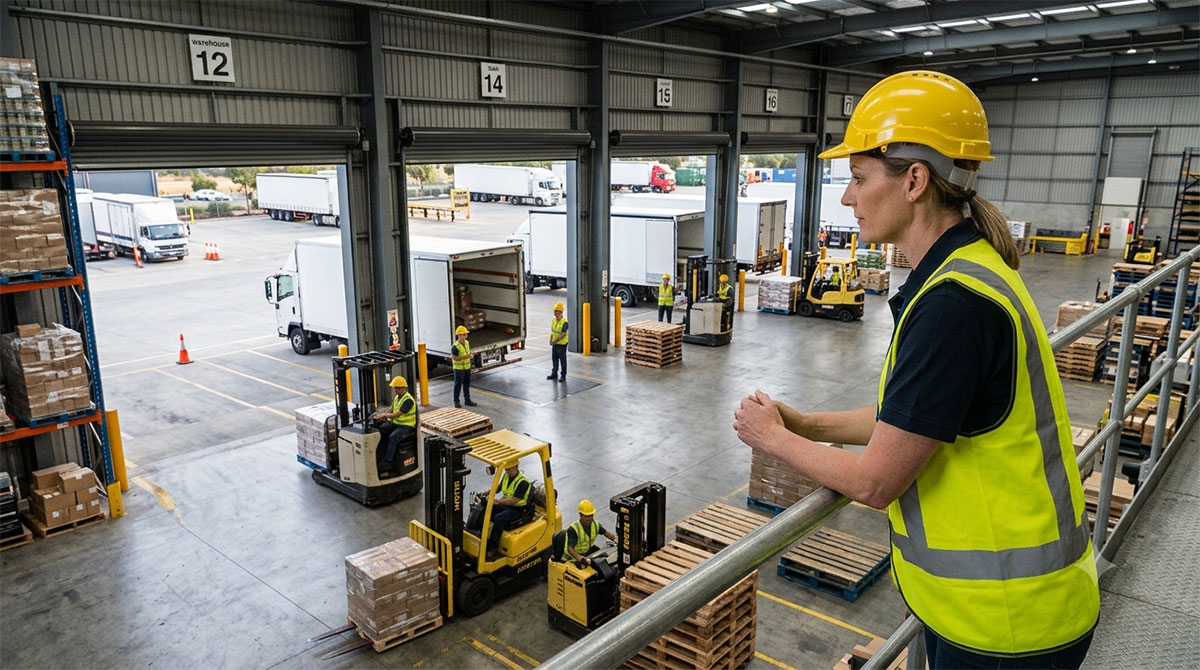
Individually, these are reasonable decisions. Collectively, they create an operation in which the person managing a driver’s route can’t easily see what’s happening at the warehouse dock the driver is about to enter, and the warehouse manager has no direct line of sight to the vehicles queued outside.
How data silos affect decision-making
IBM’s research on supply chain integration notes that many supply chain exceptions today, including late shipments, inaccurate inventory, and supplier delays, stem from gaps in system connectivity rather than a shortage of intelligence. The practical effects appear well before anyone uses the word “silo” to describe them.
Duplicate reporting
Instead of one report, multiple teams build their own dashboards, often using slightly different definitions of the same metric, so the numbers don’t reconcile when leadership compares them.
Slow responses
When a vehicle is delayed, and no one has visibility into both road status and the dock schedule, the response comes via a phone call rather than a shared view of the problem.
Blind spots
Decisions are made without a full picture. A dispatcher might reroute a vehicle without knowing that the destination dock is already backed up.
Inconsistent data
The same shipment or incident can appear different depending on which system logged it, leading to disagreement about what actually happened.
Manual processes
Employees spend time reconciling spreadsheets or serving as the informal “translator” who understands how the pieces fit together. That knowledge is valuable, but it’s fragile: when that person is unavailable, the process breaks down.
None of this looks disastrous on its own. But over time, it slows teams down and makes leaders less confident in the numbers they rely on.
The real cost of disconnected fleet and warehouse operations
Fragmented data creates real business costs. It is not just an operational annoyance.
Productivity
Gartner research has found that poor data quality costs organizations an average of at least $12.9 million per year and identifies inconsistency across data sources, the hallmark of a silo, as a common data quality challenge.
Safety
In warehouse and transportation environments, disconnected systems can directly affect physical safety outcomes. Forklifts, order pickers, and powered platform trucks were linked to 84 work-related deaths in the US in 2024, along with 25,110 injuries resulting in days away from work, job restriction, or transfer across 2023 and 2024, according to the National Safety Council. When fleet, warehouse, and safety systems operate independently, it is harder to see where vehicles, equipment, and people intersect. Those are often the moments when risk is highest.
Operational efficiency
McKinsey’s most recent Global Supply Chain Leader Survey found that nine in ten leaders faced major supply chain challenges in 2024 and highlighted persistent gaps in companies’ ability to identify and mitigate supply chain risks. Separately, the 2025 MHI/Deloitte Annual Industry Report, based on responses from more than 700 supply chain leaders, found that 75% of companies view supply chain synchronization and coordination as somewhat challenging, while more than 25% view it as very or extremely challenging.
Customer service
Deloitte’s 2025 Global Chief Procurement Officer Survey highlights risk management as a priority for procurement leaders operating in uncertain conditions. The point is simple: if leaders cannot see the problem early enough, they cannot respond quickly enough to protect customer commitments. Taken together, the research points in the same direction. Disconnected data is not a back-office inconvenience. It affects cost, safety, and service.
What unified operational visibility looks like
Eliminating a data silo does not mean replacing every system with one piece of software. It means making the data already sitting in fleet, warehouse, safety, and compliance systems visible, reliable, and useful in one place. That is where fleet data integration becomes practical: it gives operations leaders a way to connect information from vehicles, assets, warehouse systems, safety tools, and business platforms without asking teams to rebuild their workflows from scratch.
In practice, that usually comes down to a few basics:
Shared data
Instead of each system maintaining its own version of events, data flows into a shared structure that serves as a single source of truth for every relevant team. This doesn’t require abandoning existing platforms; it requires connecting them.
Real-time visibility
Reports that update overnight or weekly can’t support decisions that must be made in the moment, such as adjusting a route or reassigning warehouse labor.
Faster decision-making
When operations leaders can see the full picture, from vehicle location to dock schedule to safety alerts, they can act on what’s actually happening rather than on what a report told them an hour ago.
For example, one view could show a delayed vehicle, a congested dock, an open safety alert, and an affected customer order in the same context. Without that, four teams may end up comparing four different reports before anyone can act. This is the practical value of integrating warehouse and fleet management: teams get a shared picture of what is happening from the warehouse floor to the road.
Better collaboration
Perhaps the most understated benefit: when fleet and warehouse teams work from the same data, conversations shift. Instead of debating whose numbers are right, teams can focus on solving the problem at hand.
The exact setup will differ from one organization to the next. The goal is the same: a single, trustworthy operational view instead of scattered, disconnected systems.
Questions to ask technology providers about breaking down data silos
If your organization is evaluating how to connect fleet, warehouse, safety, and compliance data, a few questions can help distinguish a genuine integration strategy from a surface-level dashboard:
- How does the data actually get connected? Ask whether the platform pulls data via native integrations, open APIs, or manual exports, as this affects how current and reliable the information is.
- Is the data real-time or batch-updated? Understand the actual refresh rate behind any "real-time" claim.
- Can it work with the systems we already have? A unified view shouldn’t require ripping out every existing platform to get there.
- Who owns and controls the data? Clarify what happens to your data if you change providers, and who can access it in the meantime.
- How is the data presented to different roles? A fleet manager, warehouse manager, and safety leader all need different views of the same underlying information.
- What happens when something goes wrong? Ask how the platform surfaces and escalates exceptions, rather than simply logging them for a later report.
These questions will not eliminate every silo overnight, but they will show whether a provider is solving the real integration problem or simply adding another system to manage.
Why this is becoming a strategic priority
Data silos rarely form on purpose, but they do not stay harmless for long. As fleet and warehouse operations become more complex, and as customer, regulatory, and safety expectations rise, the cost of disconnected systems compounds. What once looked like background inefficiency is now a strategic risk: slower decisions, inconsistent reporting, and, in some cases, safety issues that better visibility could have helped prevent.
Solving the problem does not require a sweeping technology overhaul. It starts with a clear view of where operational data lives, who needs to see it, and where the gaps are. That’s why Powerfleet built its Unity platform: to connect data across on-road, warehouse, safety, compliance, and third-party systems into one operational view teams can trust. With Unity, teams spend less time reconciling reports and more time acting on what the data shows.
Contact us to explore how Unity helps teams close the gap between road and warehouse operations and turn disconnected data into a clearer, more actionable view of the business.