Solutions
  Products
  Industries
 Resource Center
  Company
  Contact Us

 North America
  Europe
  Deutschland
  Asia-Pacific
  Canada (Français)
  Africa
  Argentina
  México
  Brasil
 By Brodie von Berg, Managing Director, Australasia at Powerfleet
There are 4.8 people killed on our roads each year per 100,000 people in the general population in Australia. In the workplace, there are 6.7 people killed per 100,000 machinery operators and drivers. Therefore, one person in every 15,000 machinery operators or drivers is killed at work each year.
There are also more than 400 serious work injury claims in Australia each day that result in a week or more of lost work time. In 2024 alone, 188 Australian workers died from traumatic workplace injuries. Vehicle incidents accounted for 79 (42%) of those deaths, more than triple the next most common cause
None of that is new information. What should concern us is the pattern behind it. Vehicle incidents have been the deadliest mechanism in Australian workplaces for ten years. Over the same period, companies have adopted improved safety controls, from training to monitoring and reporting. This looks like driver and machinery operating training, drug & alcohol screening, hazard identification, near-miss reporting, and a mass of reports.
Think about what else happened in those ten years. Fleets that once had no visibility into what happened between the depot and the delivery now have camera recordings of nearly all of it. Warehouses added sensors, alarms, and traffic management plans. Almost every operation I walk into has more safety data than it did a decade ago, often by an order of magnitude.
We have not been short on investment, nor on data. We have been short on something else.
Here is what I think it is. Most of the technology we have bought is very good at telling us what already happened. It is much weaker at telling us what is about to happen. A camera gives you an excellent account of an incident after the fact. It does not tell you that a driver’s behaviour has been drifting for three weeks, or that the same blind corner in your yard has produced four near misses since March. The warning signs are usually there. They are just spread across systems that do not talk to each other, reviewed by people who do not have time, and noticed properly only after something has gone wrong.
That is the gap. Not a lack of data. A lack of early warning.
Five signs your safety strategy is still reactive
If you want a quick read on where your own operation sits, here are five things I look for. They are uncomfortable questions, which is the point.
1. You can only see risk after the fact.
Ask whether anything in your current setup would flag a developing problem before it’s too late to act. If the honest answer is no, you are managing incidents rather than preventing them.
2. Your team is stuck in review mode.
If your safety people spend more hours searching through footage than coaching drivers and operators, the technology is generating work rather than removing it.
3. On-road and on-site safety live in separate systems.
Vehicles in one platform, forklifts and yard equipment in another. Risk does not respect that boundary, but your reporting does, so patterns that cross it stay invisible.
4. Your data explains the past but not the next move.
A dashboard that tells you what happened last month is a record. A useful system tells you which five things need attention this week.
5. You measure activity, not outcomes.
Reports filed, inductions completed, alerts closed. All worth doing but not moving the needle.
Most operations I speak to recognise at least two. That is not a failure of effort. It is a design problem, and it is fixable.
From recording to anticipating
The shift I would argue for is from recording to anticipating, and this is where AI earns its place. Not as a replacement for the people who run safety, but as the tool that does the first pass they no longer have time for.
In practice, it comes down to three jobs.
Detect.
Pick up the behaviours and conditions that raise risk, whether that is fatigue and distraction behind the wheel or a pedestrian moving through an area where a forklift is operating.
Prioritise.
Sort what matters from what does not, so a manager starts the week with the handful of events worth their attention rather than a queue of several hundred alerts.
Connect.
Bring the on-road and the on-site picture into one place, because the operation is one operation even when the software is not.
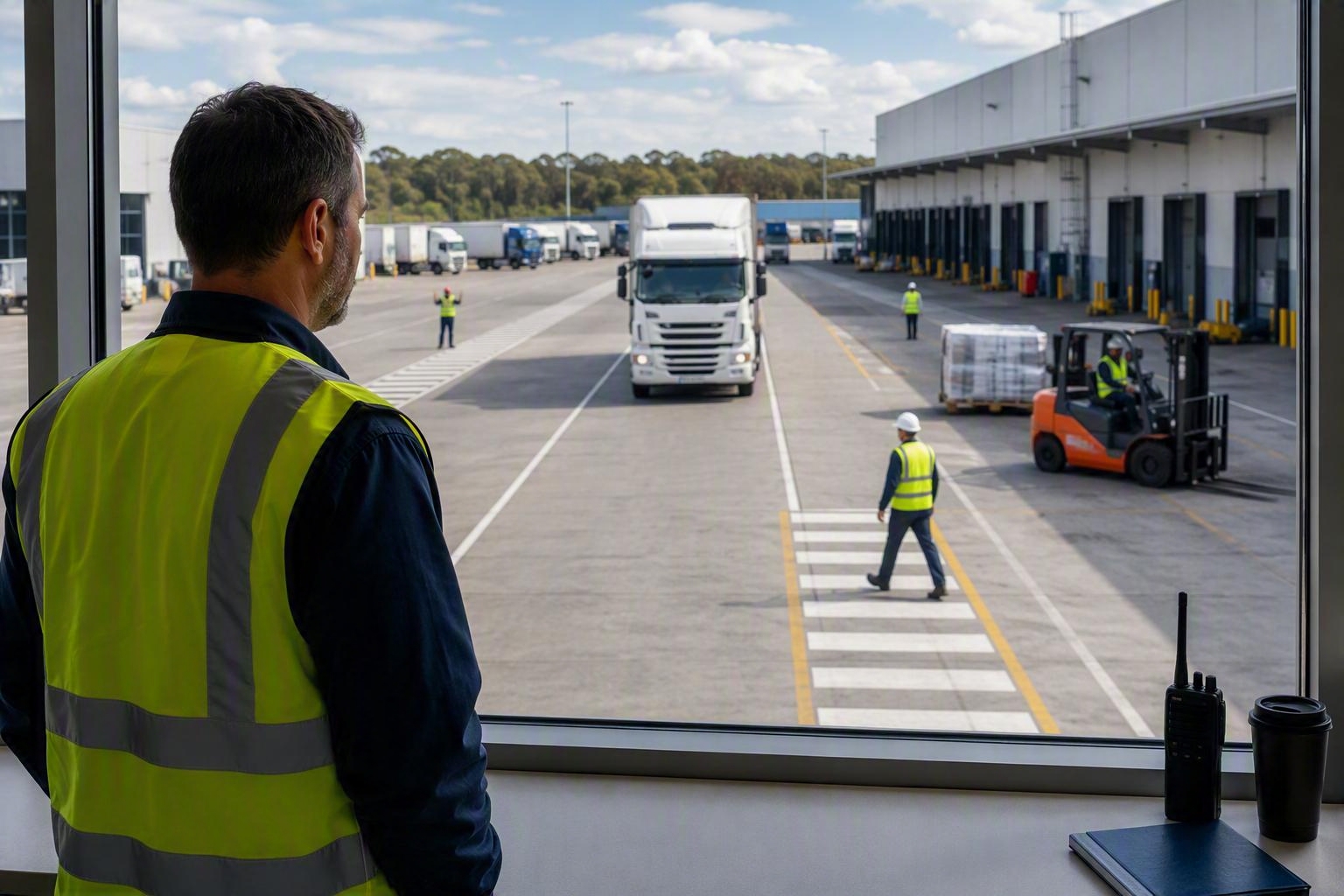
That last one is the piece most often missing. A truck fleet and a distribution centre are usually managed as separate safety problems by separate people using separate tools. The driver who arrives fatigued is the same person who then operates a forklift. Seeing both halves together is not a reporting nicety. It is how you notice things early.
None of this removes the judgement call. A person still decides who needs a conversation and what changes. They just get to that decision sooner, with better information, and while it still counts as prevention rather than investigation.
See it for yourself
I would rather show this than describe it. At MEGATRANS 2026 from 16-17 September, we will have the full picture running on the stand: in-cab video intelligence, forklift access control, pedestrian detection, and the connected view in Unity that pulls it together. Bring your hardest question about your own operation. Those are the conversations worth having.
For more information and to book a time at our stand, click here.