Solutions
 Products
 Industries
 Resource Center
 Company
 Contact


 North America
 Europe
 Deutschland
 Asia-Pacific
 Canada (Français)
 Africa
 Argentina
 México
 Brasil
By the time a commercial vehicle reaches public roads, much of the journey has already been shaped. Someone has selected the vehicle, prepared and secured the load, checked for defects, assigned the driver, set the delivery window, and planned the route. Those decisions travel with the vehicle.
Road safety therefore extends beyond the person behind the wheel. Fleet safety begins with the operating system for the journey: the load, vehicle, driver, site and plan.
One journey, several operating environments
Businesses often divide safety by location or department. Warehouse teams manage material handling, yard teams manage vehicle movements, and transport teams manage the fleet.
The boundaries make organisational sense. They make less sense when viewed from the journey. The same vehicle that reverses towards a loading bay may be travelling at road speed soon after. The load prepared inside the warehouse stays with it. So do unresolved defects, time pressure, and fatigue.
The UK Health and Safety Executive's workplace transport guidance provides a useful framework beyond its own jurisdiction. It covers safe sites, vehicles and drivers, while its guidance on driving and riding safely for work covers safe journeys, drivers or riders, and vehicles. Vehicle condition and driver readiness matter on both sides of the gate. Journey planning connects them.
In 2024, transport ministers from more than 60 countries called for businesses to address road safety along their value chains. The following year, the World Health Organization and International Transport Forum launched a global framework to help companies integrate road-safety practice into operations and value chains. Road safety is an organisational responsibility before it becomes an individual task.
Load securing is part of the road journey
Loading happens off-road. Its consequences do not stay there.
The International Road Transport Union's guidance on safe load securing explains that an improperly secured load can fall from a vehicle, affect its balance, or cause a rollover. It treats load safety as a system encompassing the vehicle, packaging, load configuration, containment, and restraint, with responsibilities extending beyond the driver.
That changes the management question. 'Did the driver check the load?' is necessary but incomplete. Leaders also need to know who selected the vehicle, who understood the load's characteristics, who secured and inspected it, and how concerns were handed over.
This is a direct link between warehouse work and road risk. Weight, distribution, restraint, and vehicle suitability are not finished warehouse tasks once the doors close. They are conditions of the journey.
Vehicle roadworthiness is decided before departure
The same is true of vehicle condition. A pre-use vehicle inspection, sometimes called a pre-trip inspection, cannot make a journey safe by itself, but it provides an opportunity to find a defect before the vehicle leaves.
HSE guidance recommends daily checks, planned maintenance, defect reporting, and immediate repairs. Its road-safety guidance also identifies vehicle condition as one of the main areas organisations should consider when managing work-related journeys. These are useful operating principles, not a statement of legal requirements outside the UK.
The harder issue is what follows. If a fault is found, who can stop the departure? Can dispatch see that it remains open? A checklist that does not trigger ownership, escalation, and resolution merely documents the risk rather than controlling it.
Driver fatigue and readiness begin with the plan
Drivers remain responsible for their behaviour. Shared responsibility must never obscure that point. But organisations set many of the conditions under which drivers make decisions: working hours, shift patterns, workload, training, route familiarity, rest opportunities, and delivery expectations.
Fatigue makes the relationship clear. The US National Institute for Occupational Safety and Health identifies inadequate or low-quality sleep, long working or driving hours, shift work, stress, and sleep disorders as sources of fatigue that can affect safe driving. Its advice to employers includes setting limits on overtime and consecutive shifts, maintaining sufficient staffing, and managing fatigue as an organisational risk.
Telling a tired driver to stop is essential, but it is a last resort. Staffing, rostering, and workload decisions have already shaped the situation. A credible policy must allow drivers to report that they are unfit to continue without shifting the pressure elsewhere.
The delivery plan matters for the same reason. HSE journey-planning guidance advises organisations to calculate travel times that allow safe driving, account for traffic and road conditions, consider fatigue when setting schedules, and avoid pressure that might encourage unnecessary risk. It also recommends allowing enough time at collection and delivery points to load and unload safely.
A demanding schedule does not automatically lead to unsafe driving. The causal chain is not that simple. But a plan built on perfect traffic, instant loading, and no need to rest removes options. The driver inherits the shortfall between the plan and reality.
Yard safety matters for different reasons
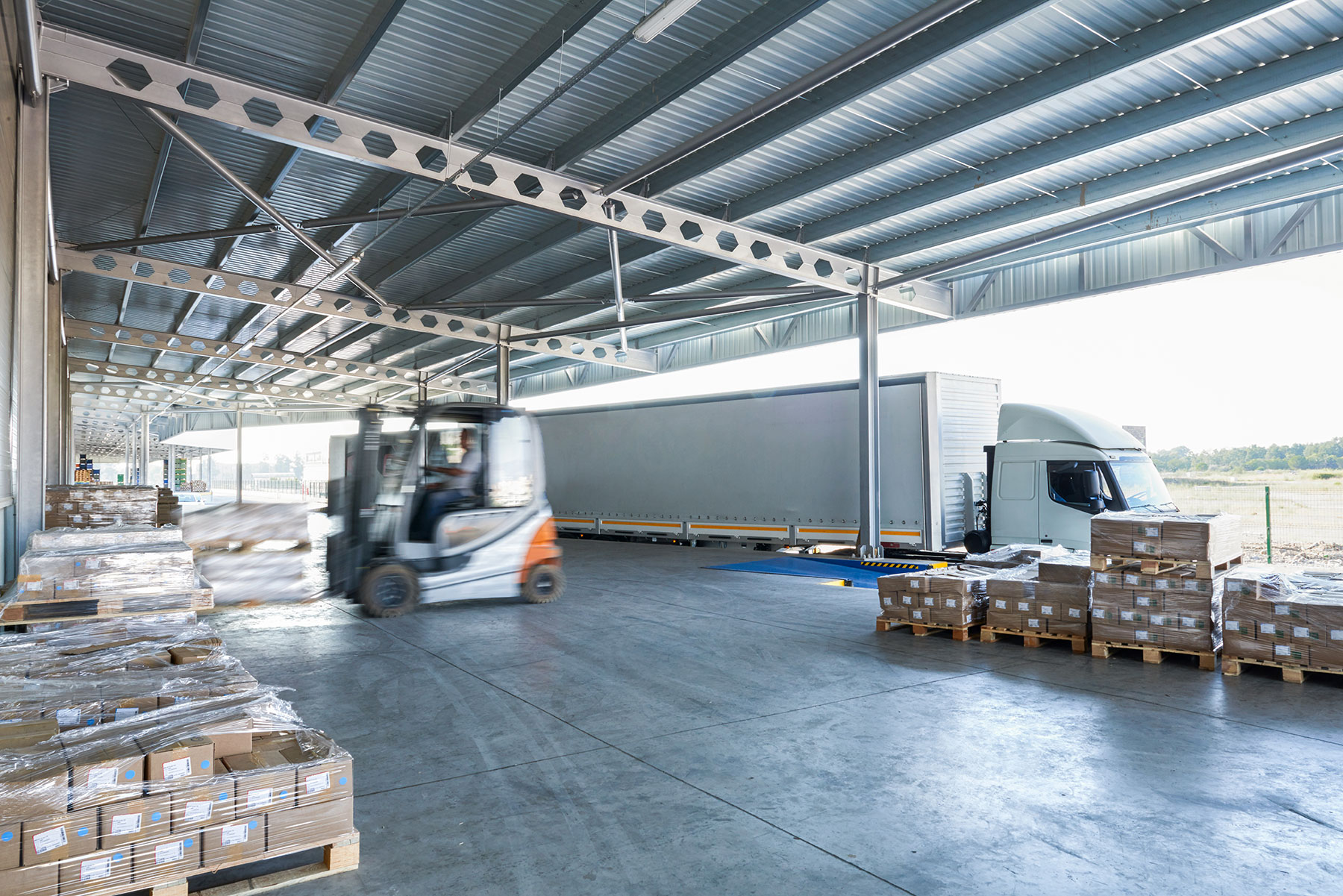
The yard is a working transport environment where vehicles reverse, forklifts move loads, pedestrians cross traffic routes, and visiting drivers may be unfamiliar with the layout.
The US Occupational Safety and Health Administration's forklift guidance recommends separating forklift traffic from pedestrians where possible, using pedestrian walkways and warning pedestrians when vehicles approach. Its loading-dock guidance addresses hazards such as dock edges, slippery surfaces, and forklift tail swing.
These controls primarily protect people on site. It would overstate the evidence to claim that pedestrian segregation or a low-speed yard rule directly reduces collisions on public roads. The link to the subsequent journey appears clearer for load security, vehicle condition, driver readiness, fatigue, route planning, and schedule pressure.
The risks differ, but the management principle is the same: understand how people, vehicles, and equipment move and interact. They belong to the same system, even when the controls and outcomes differ.
Risk gathers in the handovers
A commercial journey can pass through warehouse staff, loaders, maintenance teams, yard managers, planners, dispatchers, and drivers. Each may complete a task correctly, while a risk between tasks remains unowned.
A defect is logged but not closed. A load is secured, yet the driver is not told how or when to check it. A delivery slot ignores conditions at the destination. Yard and road events are reviewed separately, so patterns go unnoticed.
More checklists will not fix a broken handover. Organisations need clear decision rights, an escalation path, and a shared view of the evidence. The useful question is not only “Was the procedure followed?” but also “What happened to the risk when responsibility changed hands?”
Connect the evidence, not just the systems
Fleet safety technology can make inspections visible, escalate defects, verify operator authorisation and add context to impacts or unsafe interactions. It cannot replace competent people, maintenance, training, safe work practices, or management accountability.
Powerfleet's Unity platform brings operational data from warehouses, yards, and roads into a single AIoT platform. Relevant capabilities include digital pre-shift checks, operator access control, proximity alerts, impact detection, speed management, equipment health information, and road-safety video. Used together, these capabilities can help teams investigate events and identify recurring patterns across sites, shifts, vehicles, and journeys.
More data does not automatically make an operation safer. But fragmented evidence makes weak handovers harder to detect. Observing recurring defects, missed inspections, repeated impacts, and patterns across a shift, route, or site gives teams a firmer basis for action.
Safer journeys are built upstream
During Brake's Road Safety Week, the theme “Safe People on the Move” is a useful reminder that safety depends on more than the moment a vehicle is moving. It depends on everything that puts people and goods in motion.
Safer journeys start with a suitable load and vehicle, a ready driver, a controlled site, and a workable plan. The gate alters the operating environment. It does not reset the risk.
Where does risk go unowned in your operation? Start by tracing one journey from the warehouse to the yard to the road, and note where responsibility changes hands. Then see how Powerfleet's Unity platform can connect the evidence across those handovers, and talk to our team about building safer journeys from the start.